
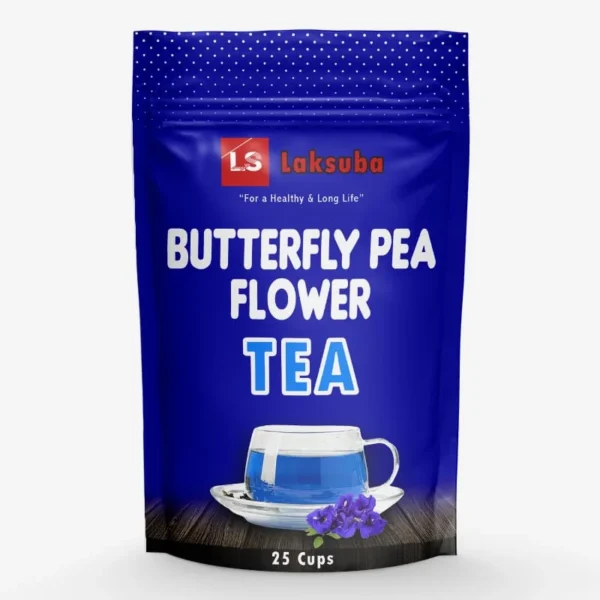
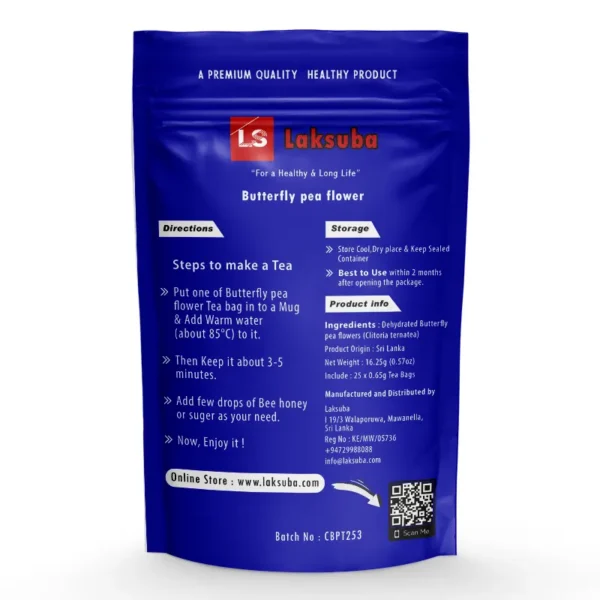

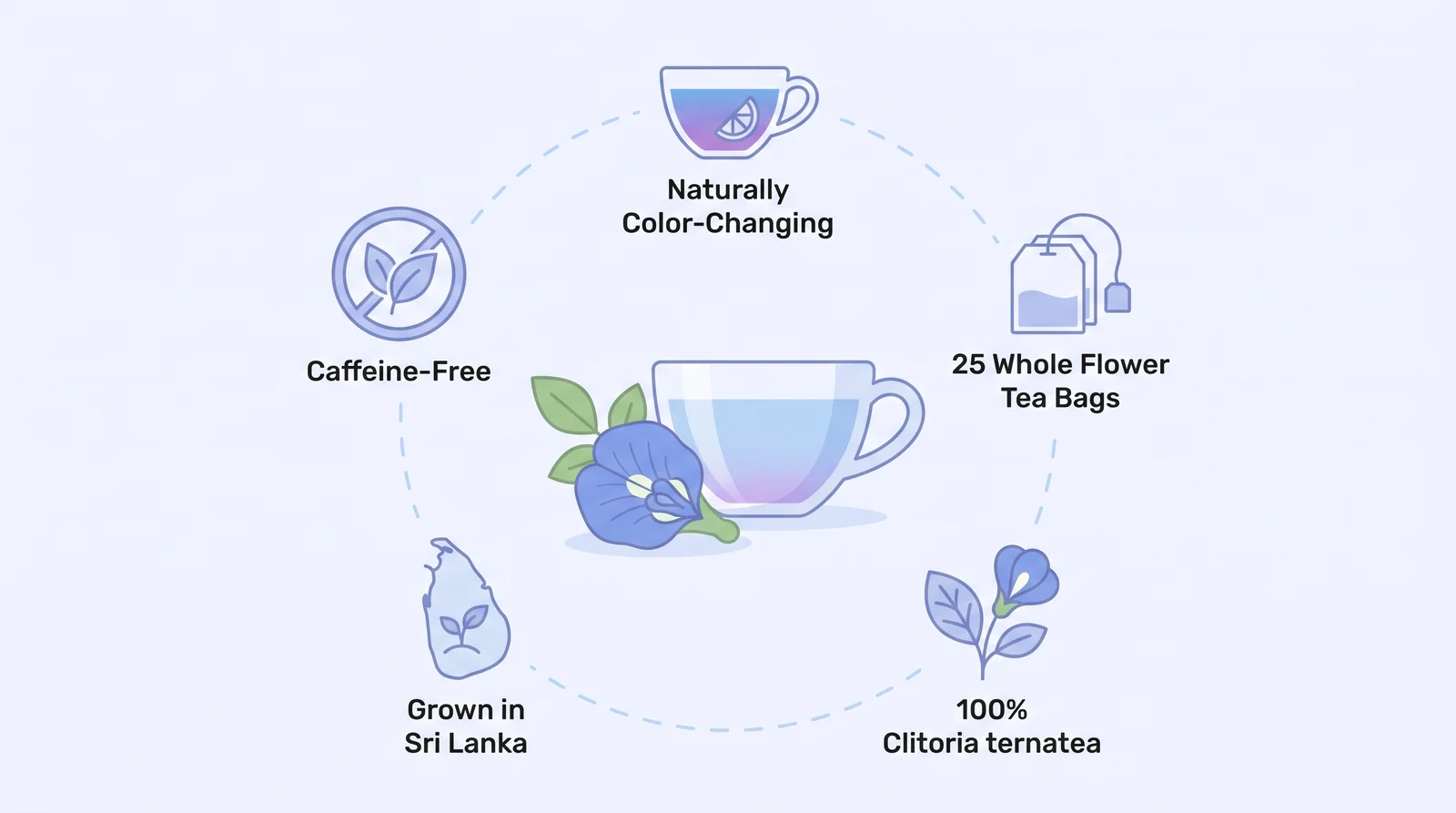
Butterfly Pea Tea is a caffeine-free herbal infusion made from the dried flowers of Clitoria ternatea, grown across Sri Lanka’s tropical lowlands. Known locally as Nil Katarolu (“blue pea flower”) and in Ayurveda as Aparajita (“the undefeated”), the flower’s pigments belong to a family called ternatins — the same natural compounds behind the tea’s best-known trick: steeped in hot water it turns a vivid blue, then shifts to violet or magenta the moment a little lemon or lime hits the cup. Laksuba’s Butterfly Pea Tea is 25 tea bags of finely ground dried flower, grown and processed in Sri Lanka, with nothing added.
- What Is Butterfly Pea Tea?
- Why Does It Turn From Blue to Purple?
- Health Benefits, Backed by Real Clinical Research
- From Aparajita to Nil Katarolu
- How to Brew It, Hot and Iced
- What’s Inside Every Pouch
- Who Should Be Careful With This Tea
- Shipping to the USA, Australia and Beyond
- You May Also Like
- Storage & Quality
- Frequently Asked Questions
What Is Butterfly Pea Tea?
Butterfly Pea Tea is made exclusively from the flower of Clitoria ternatea, a flowering vine in the pea family native to South and Southeast Asia and grown widely across Sri Lanka. Unlike teas that blend several plant parts together, Laksuba’s Butterfly Pea Tea contains one ingredient: the dried flower, finely ground into a powder inside each tea bag, with no stems, leaves, or fillers.
The living flower has a distinctive pea-family shape — a single large upright petal marked with a pale throat, wrapped by two smaller side petals — and its deep blue-to-violet color comes entirely from natural anthocyanin pigments, not dye. It’s naturally caffeine-free, since Clitoria ternatea isn’t related to the Camellia sinensis tea plant at all.
Why Does Butterfly Pea Tea Turn From Blue to Purple?
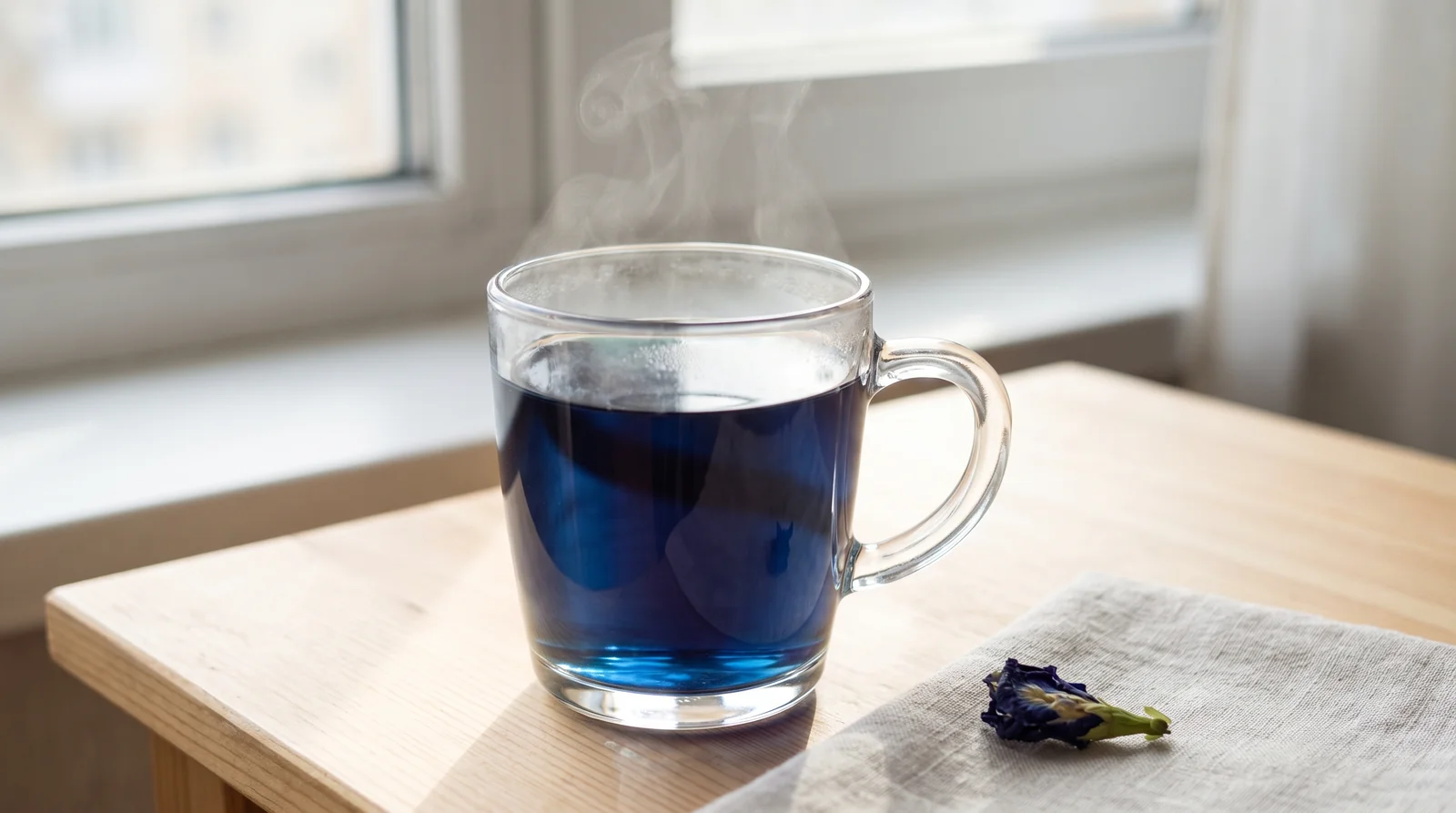
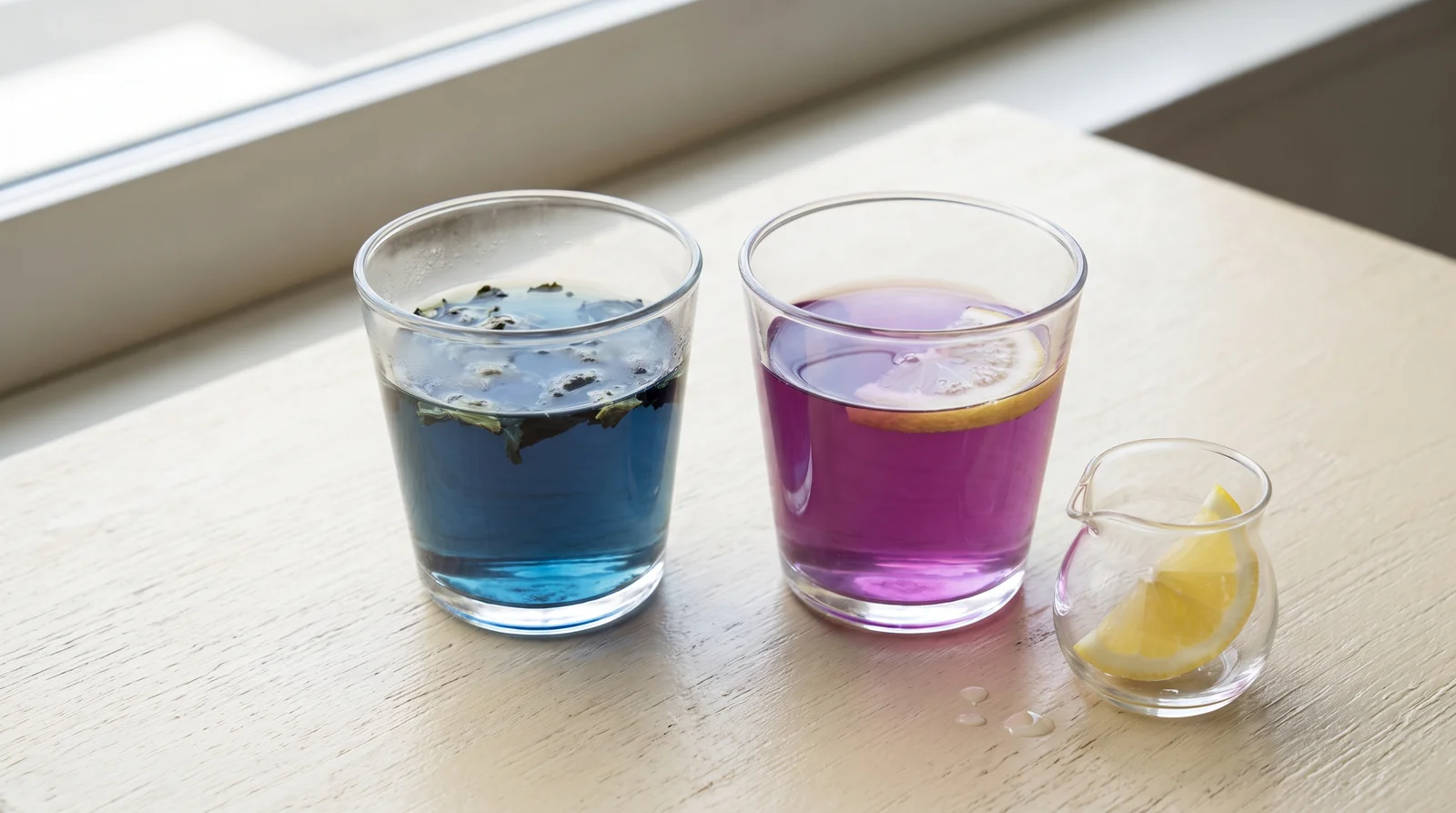
This is a real chemical reaction, not a food-coloring trick. Butterfly Pea flowers are exceptionally rich in anthocyanins — the same broad pigment family found in blueberries and red cabbage — and in Clitoria ternatea specifically, a subgroup called ternatins. Anthocyanins are pH-sensitive: in the neutral-to-slightly-alkaline water most people brew tea with, the pigment appears deep blue. Add a few drops of lemon, lime, or any acidic ingredient, and the pigment’s molecular structure shifts, turning the same cup a vivid violet or magenta in seconds.
It’s the identical chemistry behind red cabbage water turning pink with vinegar — just naturally occurring in the flower itself, with no additives involved.
Health Benefits, Backed by Real Clinical Research
Most herbal tea pages list dozens of loosely-sourced benefits. We’d rather point you to what’s actually been studied in humans, specifically using the flower — not the leaf or root, which Ayurveda uses differently (more on that below).
Antioxidant support. In a randomized clinical trial, healthy adults who drank a Butterfly Pea flower beverage showed a measurable rise in plasma antioxidant capacity — measured three separate ways (FRAP, ORAC, and TEAC) — along with lower markers of oxidative stress, even without added sugar.
Blood sugar and metabolic wellness. In the same trial, when the flower extract was consumed alongside sugar, participants’ post-meal blood glucose and insulin response were measurably suppressed compared to sugar alone. A separate trial in adults with type 2 diabetes found daily use over 12 weeks reduced markers of oxidative stress. This is genuine human clinical research — not a claim that this tea treats or manages diabetes (see the safety note below and the full disclaimer at the end of this page).
Healthy response to fatty meals. In a trial with overweight and obese adults, Butterfly Pea flower extract taken alongside a high-fat meal reduced the post-meal rise in triglycerides and free fatty acids, and improved antioxidant status compared to the meal alone.
These findings are specific to the flower — not the leaf or root — and specific to concentrated flower extract in a research setting, which is a different dose than a single cup of brewed tea. We think that distinction matters more than a longer list of unproven claims. For more on this research, see this randomized clinical trial on Clitoria ternatea flower beverage (NCBI/PMC).
From Aparajita to Nil Katarolu: A Traditional Heritage
In Sri Lanka, Butterfly Pea flower is known as Nil Katarolu and has long been steeped as a warming infusion and used as a natural blue dye for rice and traditional sweets. In classical Ayurveda, the plant is called Aparajita (“the undefeated”) and Girikarnika, and appears in foundational texts including the Charaka Samhita and Bhavaprakasha Nighantu, where it’s classified as cooling (sheeta) in nature.
One important distinction: Ayurveda’s best-known use of this plant — as a traditional support for mental clarity — refers primarily to preparations from the root, not the flower. Laksuba’s tea is made from the flower only, and this page’s health information reflects what’s actually studied in the flower specifically, rather than borrowing claims that belong to a different part of the plant.
How to Brew It, Hot and Iced
Hot Brewing
- Place 1 tea bag in a cup or teapot
- Add water just off the boil (95–100°C / 200–212°F)
- Steep for 5 minutes for a deep blue color
- Add a few drops of lemon or lime just before drinking to watch it turn violet
- Sweeten with honey if desired — the flavor is mild and earthy, not vegetal
Iced / Color-Changing Serve
- Brew a stronger batch (2 tea bags per 2 cups water), steep 5–7 minutes, then cool
- Pour over ice
- Add a squeeze of lemon, lime, or a splash of fruit juice tableside for the color-change effect
- A popular base for mocktails and layered drinks
What’s Inside Every Pouch
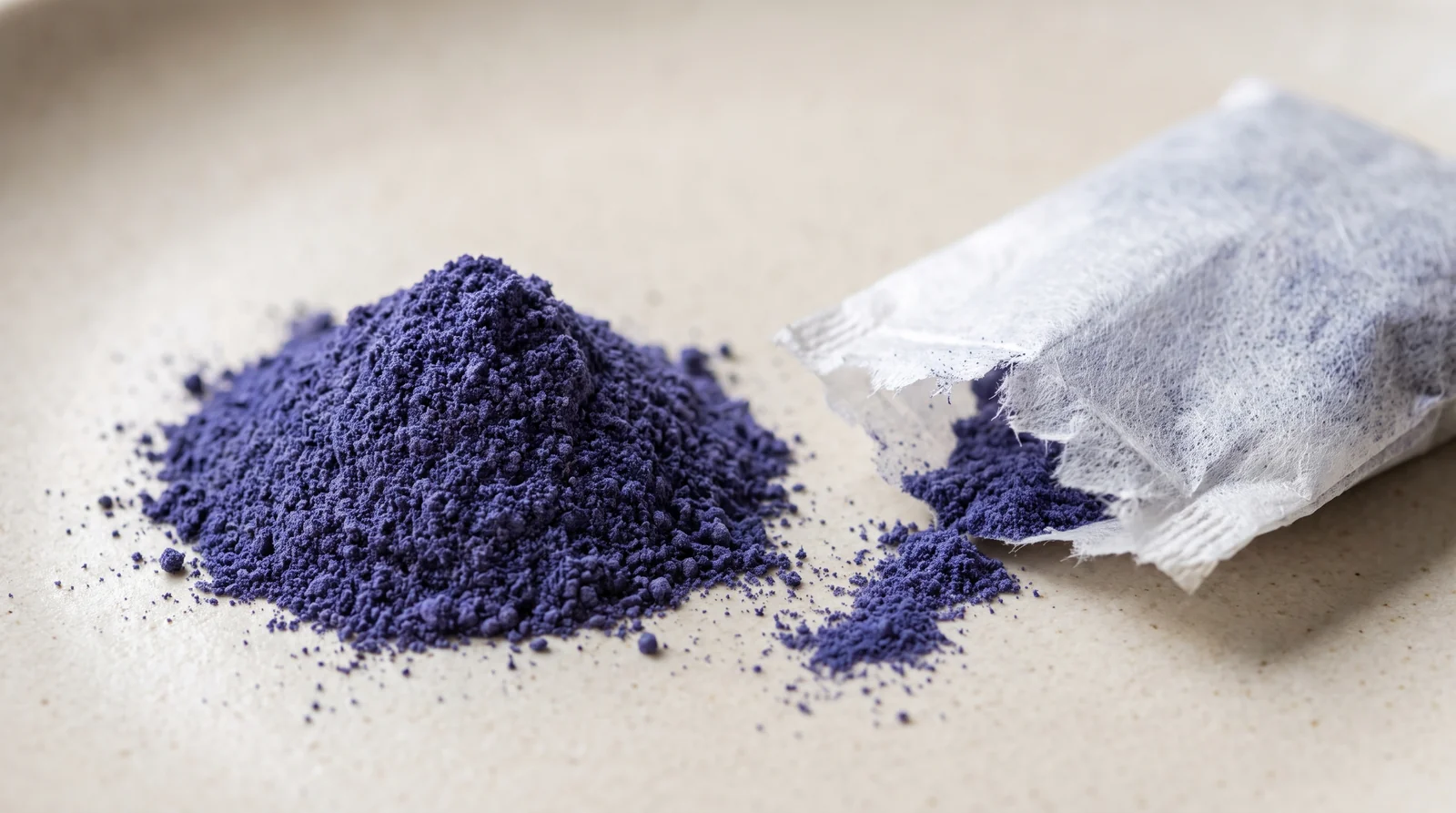
- 25 Butterfly Pea flower tea bags, finely powdered inside each bag
- Net Weight: 16.25g (0.57 oz)
- Ingredients: 100% dried and ground Clitoria ternatea flower — nothing else
- Origin: Grown and processed in Sri Lanka
- Packaging: Commercially packaged in a sealed, resealable pouch
Who Should Be Careful With This Tea
Butterfly Pea flower has a longer history of documented interactions than many herbal teas, so please read this before regular use:
- Pregnancy: Compounds in Butterfly Pea flower (cyclotides) have documented uterine-stimulating activity in laboratory research. Out of caution, pregnant women should avoid this tea.
- Breastfeeding: There isn’t enough safety data in nursing mothers, so we recommend avoiding it while breastfeeding.
- Blood thinners: Compounds in the flower may reduce platelet clumping. If you take a blood thinner (such as warfarin, clopidogrel, or regular aspirin), or have surgery scheduled, talk to your doctor before regular use.
- Low blood pressure: The flower has a mild blood-vessel-relaxing effect. If you have low blood pressure or take medication for it, introduce this tea gradually and watch for dizziness.
- Blood sugar medication: Given the research above, talk to your doctor before regular use if you take medication for diabetes.
This is general information, not medical advice — see the full note at the end of this page, and speak with your doctor if any of the above applies to you.
Shipping to the USA, Australia and Beyond
Laksuba ships Butterfly Pea Tea from Sri Lanka to the USA, Australia, and worldwide. The tea is commercially packaged and thoroughly dried, meeting Australia’s biosecurity requirements for herbal tea imports (whole, non-viable dried plant material, under 1kg per pack) — so it clears customs the same way our other Ceylon herbal teas do.
Because this is a small, real business, please allow standard international shipping times shown at checkout for an accurate delivery estimate for your country.
You May Also Like
Enjoying the visual and wellness side of Ceylon herbal tea? Bael Tea (Belimal) is our traditional digestive-comfort tea, and pairs naturally with Butterfly Pea if you’re building a daily rotation. Curious about another well-studied Sri Lankan herbal tea? Our Heen Bovitiya traditional uses and growing guide is a good next read. Browse the full Ceylon Herbal Tea collection for more.
Storage & Quality
- Store in a cool, dry place in the resealable ziplock bag
- Keep away from direct sunlight and moisture
- Our eco-friendly packaging helps maintain freshness
- 30-day satisfaction guarantee – your wellness journey is risk-free
Frequently Asked Questions
Does the tea really change color, or is that a chemical additive?
It’s real chemistry, not an additive. The flower is naturally rich in anthocyanin pigments that shift color with pH — blue in plain water, violet or magenta with a little lemon or lime. Nothing is added to make this happen.
What does Butterfly Pea Tea taste like?
Mild, earthy, and smooth — not vegetal or “peppery” the way the name might suggest. On its own it’s subtle, which makes it a good base for honey, ginger, lemongrass, or citrus.
Is it safe to drink every day? How many cups?
For most healthy adults, 1–3 cups a day is a reasonable amount, and it’s caffeine-free so it’s fine in the evening too. See “Who Should Be Careful With This Tea” above if you’re pregnant, nursing, on blood thinners or blood pressure medication, or have low blood pressure.
Is Butterfly Pea Tea the same as Blue Tea?
Yes — “Blue Tea” and “Blue Matcha” are both common names for the same thing: an infusion of dried Clitoria ternatea flowers. Laksuba’s tea is 100% dried and ground Butterfly Pea flower, sometimes known locally as Nil Katarolu.
Are the tea bags filled with whole flowers or ground tea?
Each tea bag of Butterfly Pea Tea contains finely ground, dried Butterfly Pea flower — not whole or loose flowers. Grinding it this way gives an even, consistent color and flavor every time you steep a cup.
Are the tea bags and ziplock bag made using eco-friendly materials?
Yes — both the tea bags and the resealable ziplock pouch are made from eco-friendly materials.
Can I drink this if I’m pregnant?
We recommend avoiding it during pregnancy. Compounds in the flower have documented uterine-stimulating activity in laboratory research, so this isn’t a tea to take chances with — talk to your doctor if you’re unsure.
Why did my urine change color after drinking this?
This is a harmless, commonly reported effect of the natural plant pigments being excreted, similar to how eating beets can temporarily change urine color. It isn’t a sign of a problem.
These statements reflect traditional and researched uses of Clitoria ternatea flower. These statements have not been evaluated by the FDA. This product is not intended to diagnose, treat, cure, or prevent any disease. Individual results may vary. Please consult your healthcare provider before use if you are pregnant, nursing, taking blood-thinning medication, taking medication for blood sugar or blood pressure, or have a medical condition, and discuss stopping use ahead of any planned surgery.


Scarlett –
KamaniWijesinghe –
Caleb –
Dinesh –
Aria –
Sandamali –
Nathan –
Jack –
Thilini –
Asela Gunawardena –